
Common Sense, Common Good: Problems and Causes

Restructuring the Republic: The 2026 Quantum Constitutional Convention
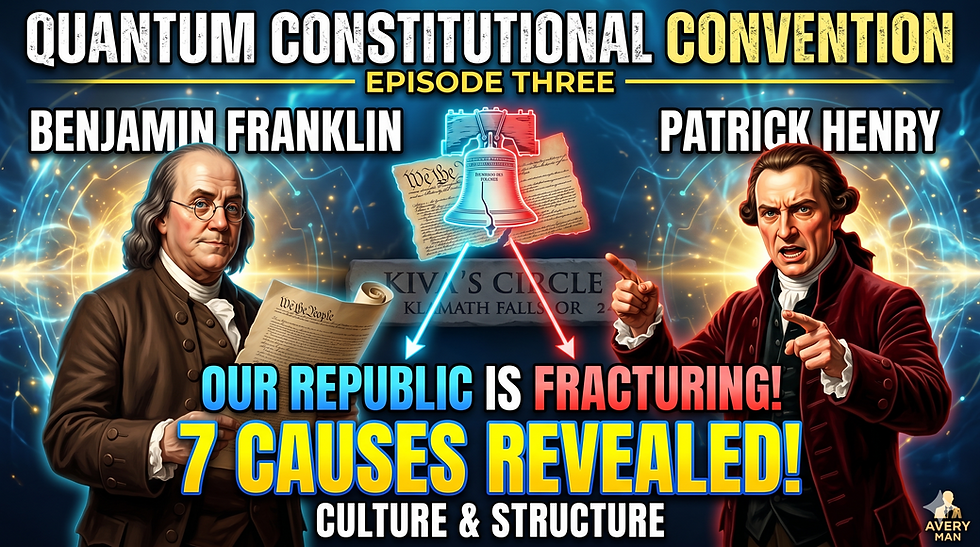
By Avery Man Representative of the Common Humanity of America
Welcome to Episode Three of our series: Self-Government and Consent of the Governed. We call this episode "Two Causes: Culture and Structure." If you tuned into our first episode, you know about the extraordinary experiment currently taking place in the quantum field. Benjamin Franklin and Thomas Paine have reconvened all the original delegates from the 1787 Constitutional Convention in Philadelphia. But this time, the roster has been enhanced.
Four critical voices who were missing in 1787 have finally taken their seats: Thomas Jefferson and John Adams (who were serving as ambassadors in France and England), Patrick Henry (who originally refused to attend because he "smelt a rat!"), and Thomas Paine himself. This brings our modern, quantum delegation to 59 brilliant minds.
Franklin and Paine posed three urgent questions to this historic body regarding the state of our union today. Here is what they found.
The Delegates Face Three Hard Truths
To gather a baseline of where our country stands in 2026, the delegation voted on three crucial questions. The results were sobering.
1. Are you satisfied with the state of the United States as it functions now?
While the delegates expressed pride in America’s economic and military success, very few were even faintly satisfied with how the federal government functions today. They deeply understand the frustrations of regular citizens.
2. Should there be another Convention to "Alter" the Constitution?
The Declaration of Independence asserts that the people have an inherent right to alter or abolish a government that no longer serves them. When put to a vote, the 59 delegates split into three camps:
Over One-Third: Supported a full, new convention to extensively alter the Constitution.
Over One-Third: Believed the same goals could be achieved via targeted individual amendments and legislative statutory reforms.
Exactly One-Quarter: Opposed a full convention, believing political pressure and existing legislative procedures are sufficient to cure our ills.
3. What are the core problems—and root causes—contributing to America's political crisis?
To answer this, Benjamin Franklin and George Washington led two intense days of deliberation. They challenged the delegates to frame America's issues in broad, abstract terms to ensure the conversation didn't devolve into finger-pointing between modern political factions.
The delegation concluded that every single symptom of our current political sickness traces back to just two root causes: Culture (Epistemology) and Structure.
Culture (Epistemology): How citizens reach conclusions about Truth, Legitimacy, and Faith. It is defined by shared beliefs, public myths, trusted authorities, and moral values.Structure: The design of social and political power through institutions, rules, incentives, voting systems, and hierarchies of accountability.
The Seven Core Problems Defacing the Republic
Through meticulous notes kept by James Madison and Thomas Paine, the convention identified seven distinct problems plaguing modern America, categorizing each as Cultural [C], Structural [S], or both.
1. Incentives that Reward Escalation [C & F]
Definition: Modern institutional and social rewards—like campaign donations, media attention, and job security—favor outrage over cooperation.
The Mechanism: News and social media algorithms gain profit and power by promoting division, while political parties punish representatives who dare to compromise.
Consequence: Hardened polarization. Factions are natural, but our current system normalizes conflict, making legitimate legislative negotiation almost impossible.
2. Asymmetrical Accountability [S]
Definition: A massive imbalance in responsibility. The federal government strictly regulates citizens, businesses, and professions, yet public officials remain largely insulated from the consequences of their own actions.
The Mechanism: The Constitution distributes power, but it is dangerously vague on the precise limits and mechanisms to control that power.
Consequence: Impeachment has become a purely partisan exercise rather than an instrument of justice. Regular people have zero leverage over the government unless they wield massive financial weight.
3. Representation Distortion [S]
Definition: The unequal distribution of influence in the federal government, specifically favoring wealthy donors and disproportionately weighting certain geographies.
The Mechanism: The Electoral College and the structure of the Senate mean that corporate lobbyists routinely draft actual legislation, while the votes of citizens in highly populated states are mathematically diluted. (For example, Washington D.C. has 100,000 more residents than Wyoming, yet has zero representation in the Senate).
Consequence: The Constitution begins with "We the People," but immediately conceded power to the states—which have now turned that power over to two competing, corporate-backed political parties.
4. Electoral System Rigidity: The Duopoly [S]
Definition: America relies on an archaic "Plurality" (winner-take-all) voting system in single-member districts.
The Mechanism: Dictated by mathematical logic (Duverger’s Law), a plurality system naturally forces politics into a rigid, two-party dichotomy.
Consequence: The "spoiler effect." Voting for a third-party candidate naturally aids the major candidate you dislike the most. This locks citizens into a permanent, artificial binary where alternative political parties are mathematically suppressed from winning.
[Plurality / Winner-Take-All Voting]
                 │
                 ▼
[Duverger's Law: Mathematical Pressure]
                 │
                 ▼
[The Two-Party Duopoly / "Spoiler Effect"]
                 │
                 ▼
[A Hardened Binary: Friends vs. Enemies]
5. Executive Power Expansion [C & S]
Definition: The continuous, aggressive centralization of power in the hands of the President.
The Mechanism: Because congressional gridlock makes it impossible to pass budgets or critical legislation, a power vacuum is created. The Executive branch steps into this vacuum to rule via executive orders.
Consequence: The rise of a "unitary executive" that mimics a monarch or despot—the exact outcome the Anti-Federalists warned against in 1787.
6. Epistemological Fragmentation [C]
Definition: The splitting of American society into two entirely separate, competing realities that share no common standards of truth, evidence, or trust.
The Mechanism: Deep-seated human biological imperatives—tribalism, the need for belonging, and conformity—have been weaponized by distinct media ecosystems.
Consequence: Identity politics. When a society cannot even agree on basic facts or what constitutes truth, democratic deliberation becomes entirely impossible.
7. Civic Disengagement and Loss of Republican Virtue [C & S]
Definition: The transformation of American citizens from active participants in self-governance into passive spectators.
The Mechanism: Modern political messaging conditions citizens to view politics like a gladiatorial match in a Roman Colosseum, where the objective is to watch "the other side" be destroyed.
Consequence: Citizens are treated as consumers rather than stakeholders. They are trained to respond with righteous indignation and hyper-vigilance for insults, rather than exercising the civic duty required to sustain a healthy republic.
Moving Forward
As Hannah Arendt noted to the delegation, a society that cannot agree on a shared reality cannot possibly define how it wishes to be governed. If we are to honor the legacy of Paine, Franklin, and the rest of our founders, we must look honestly at these design flaws in both our national culture and our constitutional structure.
In our next episode, we will dive deeper into the concrete mechanisms of Structure—focusing specifically on the Constitution itself, and how we can begin to engineer practical, modern solutions to bridge these divides.
Until then, I am Avery Man, asking you: How will you choose to exercise your consent to be governed?
Comments